An AI content engine is a system where AI makes social media videos instead of people. AI writes the script, an AI avatar appears on camera, a synthetic voice does the talking, and software edits and publishes the video. People set the goals and check the results.
This article follows one company that built an AI content engine for short-form video, what it produced in its first 101 days, and what the same work would have cost with a human team. The short version: work that would take a studio of 42–78 people is done by one person and about $1,300 a month in subscriptions. And the person who built it is not a programmer and knows exactly one terminal command. Claude agents wrote 99.7% of the code.
The company operates in the wellness category and targets the US and other English-speaking markets. Its name, channels and revenue are covered by a non-disclosure agreement. All figures in this article come from the company's records.
Why the company needed an AI content engine
Every business wants an audience on social media. Right now short-form video is the main way to get one, and it takes a lot of it: every day, on several platforms, in several languages.
Until recently a company had two options.
It could pay influencers. That is fast, but the audience stays with the influencer, and next month you pay again.
Or it could grow its own channels. That takes a production studio: scriptwriters, on-camera talent, a camera operator, lighting and sound, video editors, voice-over artists, a producer and social media managers. It is expensive, and few businesses go that way.
This company took a third option that did not exist two years ago. It had AI agents build the studio.
One task for an AI agent
It started with a single task for Claude, written in plain English with no diagrams and no code. One of the points read: "The language and tech stack are your choice."
The person behind it is not a developer. The only terminal command this person knows starts the agent with the `--dangerously-skip-permissions` flag, so the agent does not stop to ask permission at every step. Tasks are dictated by voice, and the transcript goes to the agent.
Three days later the engine produced its first real project. It took about 20 hours of human time, and not one message to the agent contains a line of code. The agent chose the technology, wrote the software and deployed it to servers. To this day the builder cannot say what stack the content engine runs on.
The AI agent wrote 99.7% of the code in the first version. Today Claude Opus 5 runs production.
How the engine scaled
For the first eleven weeks the engine released 15 to 70 videos a week. Then it picked up speed: 146, 371 and 420 videos a week. No one was hired, and the only new subscription was a second plan for the agent.
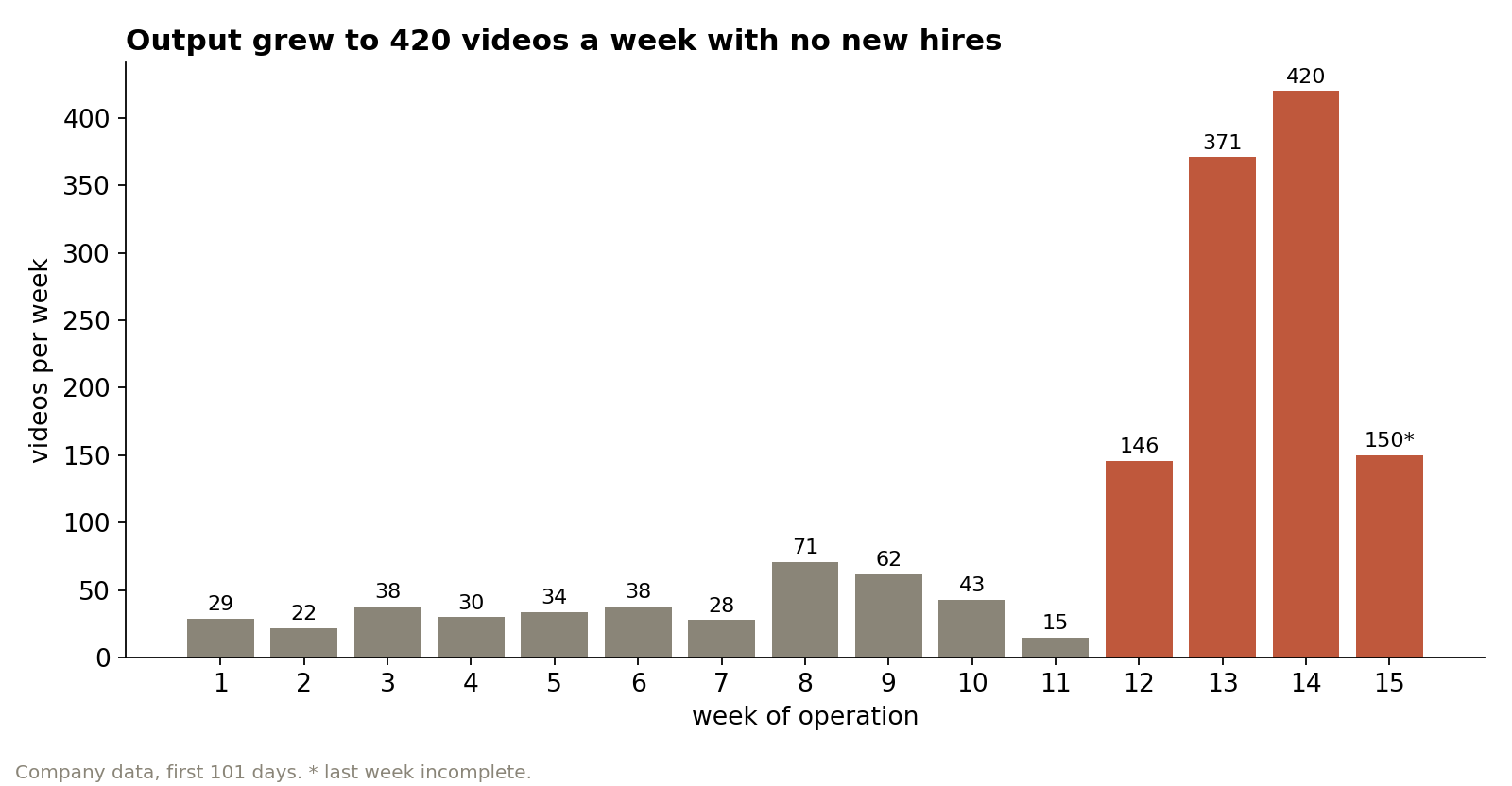
Results for the first 101 days:
- 1,497 videos and 2,137 language versions;
- 67 channels on six platforms, with YouTube bringing 90% of views;
- 8,250,024 organic views;
- 1,126,322 followers and subscribers across channels;
- about $1,300 a month in subscriptions, $4,313.76 for the whole period;
- 52 cents per 1,000 views.
This is where an AI content engine differs from paid ads. Ads work like a meter: pay $16.57, get 1,000 impressions; double the budget, double the impressions; stop paying and the impressions stop. Organic reach grows differently. Output goes up first, and views and followers catch up later. Videos keep collecting views for weeks, channels build an audience, and platforms take time to pick them up. So 8.25 million views is a snapshot, not a final number. The videos from the last weeks, when output jumped several times over, are still gaining views. And the followers the company gains stay with it after the bill is paid.
Which jobs the AI replaced
A robotaxi does not help the driver. It removes the driver's seat. The same thing happened here to the production crew. Here is who would sit in a traditional studio and who does the work now.
| role in a video studio | who does it now |
|---|---|
| scriptwriter | Claude writes and checks the scripts |
| translator | Claude |
| on-camera talent | 22 AI avatars |
| camera operator, lighting, sound, makeup | no cameras; the footage is generated |
| voice-over artist | synthetic voice |
| video editor and motion designer | automated editing, coded by AI agents |
| social media managers for 67 channels | AI agents publish on schedule and handle part of the social media work |
| software developers | Claude agents |
One person is left, setting the tasks and reviewing the results.
What the same studio would cost with people
Now imagine the company did the same work the traditional way, with a full staff.
On average the engine produced 104 videos and 148 language versions a week, or about 21 videos per workday. We could not find published productivity benchmarks for short-form video production, so the staffing below is our own estimate, given as a range:
| role | headcount |
|---|---|
| scriptwriters | 3–7 |
| translator | 1 |
| video editors and motion designers | 5–11 |
| film crews (director, camera, lighting and sound, makeup) | 1–3 crews |
| voice-over artist (language versions only) | 1 |
| producers | 2–7 |
| social media managers for 67 channels | 5–14 |
| on-camera talent | 22 |
| total | 42–78 people |
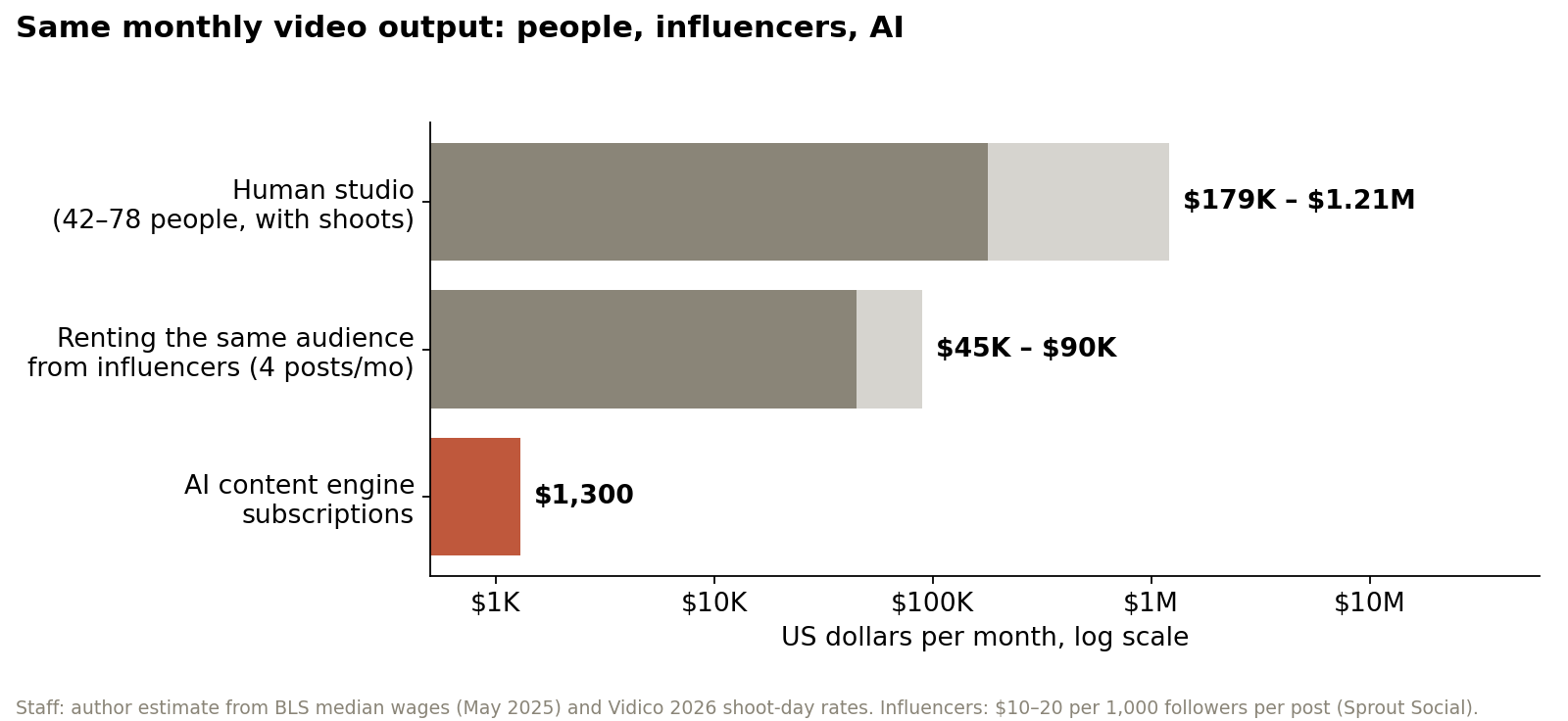
At median US wages from the Bureau of Labor Statistics (May 2025, before employer taxes), that staff costs $107,000–268,000 a month. Add production: on average 15–45 shoot days a month, with a day of crew, studio, equipment, makeup and talent costing $4,750–21,000 at the 2026 rates of the video production agency Vidico.
Total: $179,000 to $1.21 million a month. The AI content engine costs $1,300. The human studio is 138 to 935 times more expensive. The comparison favors the engine a little: its cost leaves out the builder's time and servers, while the studio includes producers.
At peak output of about 400 videos a week, it would take 69–168 people and $0.51–4.33 million a month. The AI engine got there without a single hire.
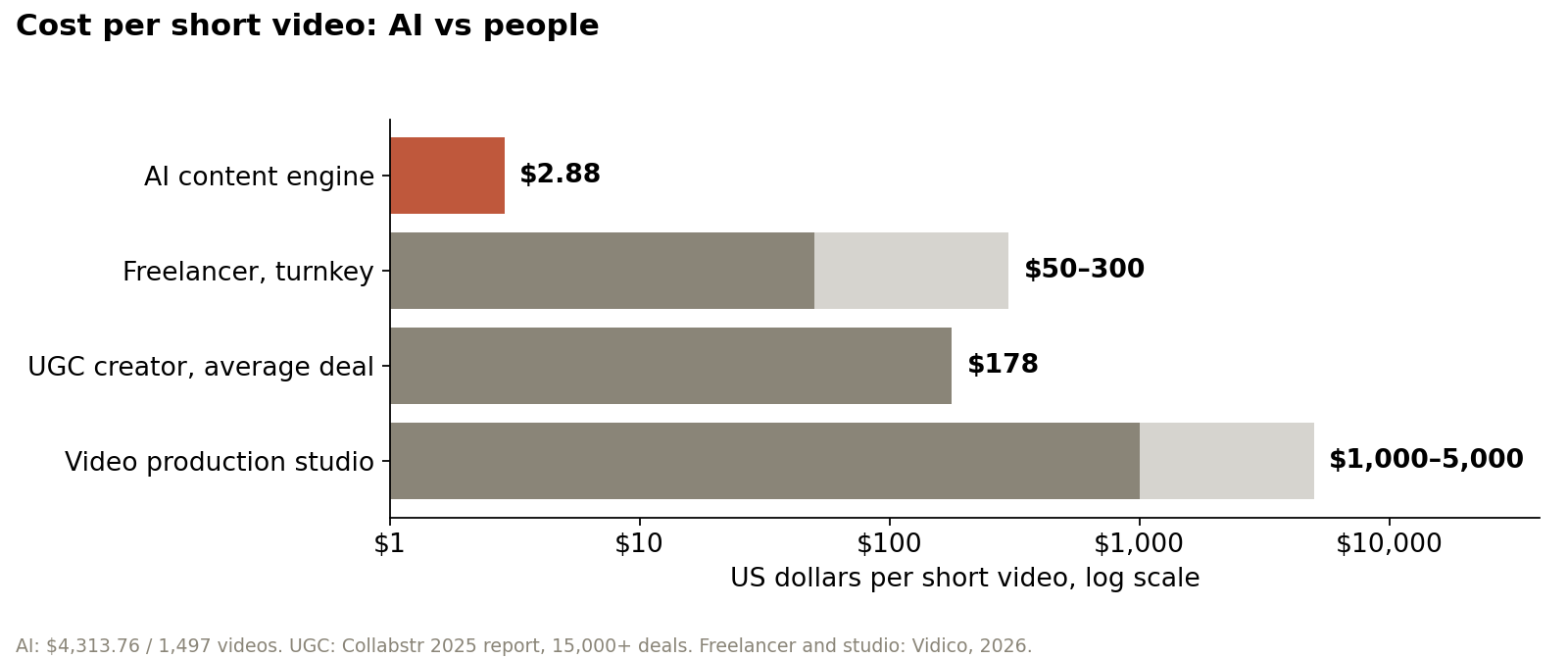
Per video, the engine costs $2.88. A UGC creator is paid $178 per video on average (Collabstr, 2025 report, 15,000+ deals), a turnkey freelancer $50–300, and a video production studio $1,000–5,000 (Vidico, 2026).
AI vs influencer marketing costs
Sponsored influencer content costs brands $2–30 per 1,000 views, and YouTube integrations $50–100 (Influencer Marketing Hub, 2026). The same 8.25 million views bought from influencers would cost $16,500–247,500, which is 3.8 to 57 times more than the subscriptions, and up to $825,000 at YouTube integration rates.
Renting an audience of the same size, 1.1 million followers, with four sponsored posts a month comes to $45,000–90,000 (the rule of thumb of $10–20 per 1,000 followers per post, Sprout Social). And you pay it every month, because the audience belongs to the influencers. This company owns its audience. Two caveats: influencer prices are for views of sponsored posts, not organic views of short videos, and part of the company's audience was built before the 101 days.
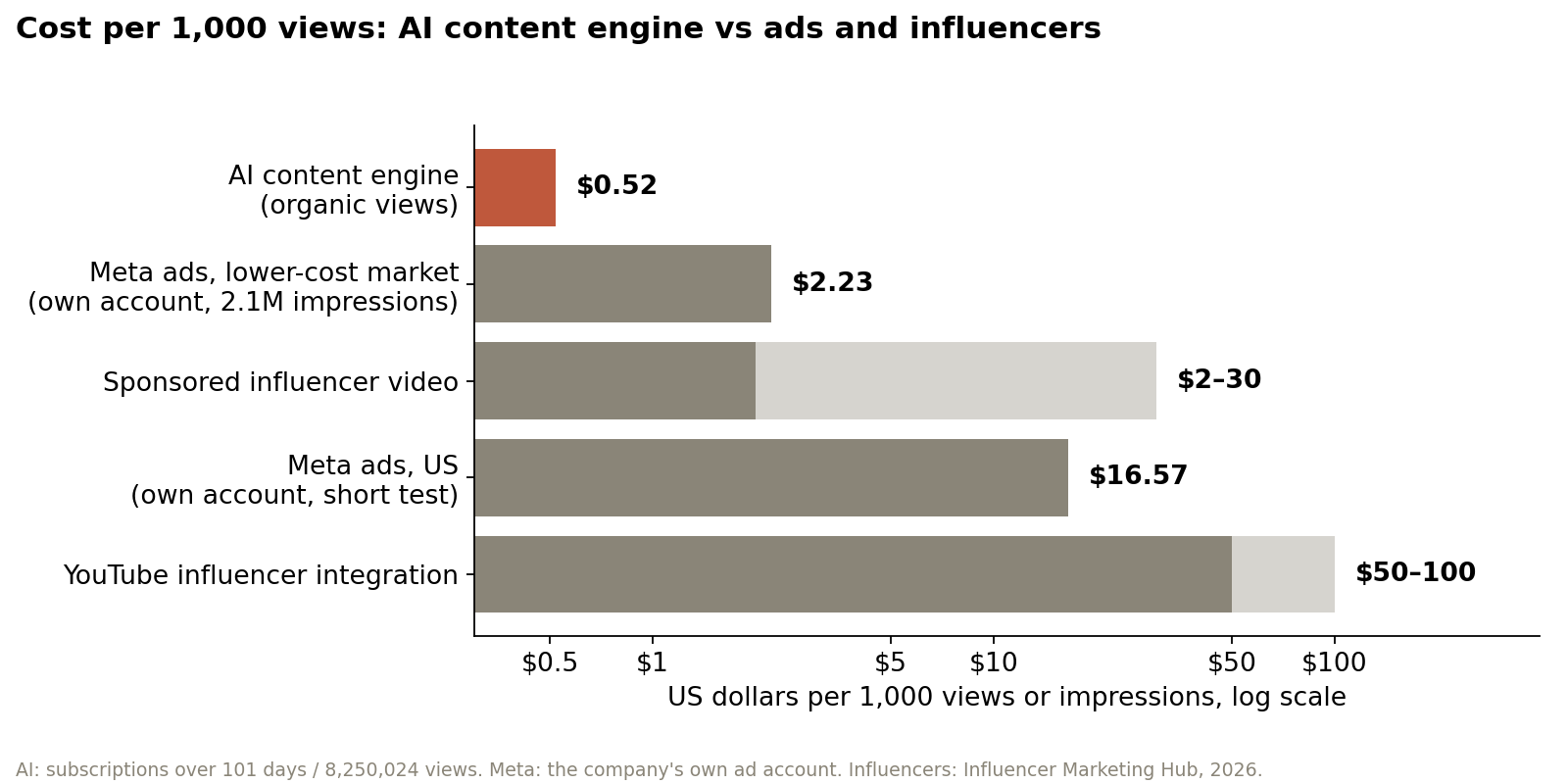
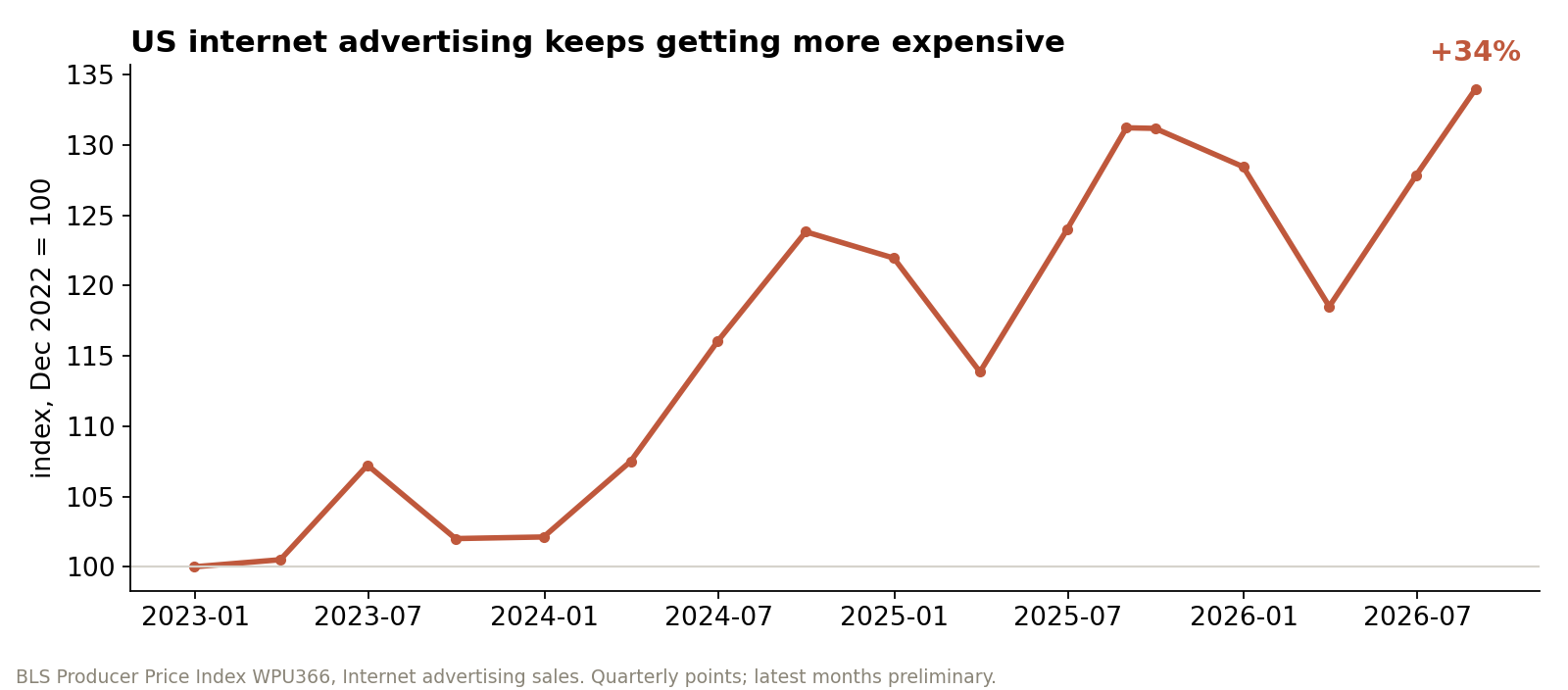
Paid social tells a similar story. The same company paid Meta $2.23 per 1,000 impressions in a lower-cost market and $16.57 in a short US test. And ad prices keep rising: the Bureau of Labor Statistics producer price index for internet advertising rose 34% from December 2022 to August 2026.
Brands worldwide spend about $32.5 billion a year on influencer marketing (Influencer Marketing Hub, 2025). Add part of the spending on video production, and by our estimate $40–50 billion a year is spent on work that engines like this can compete for.
Forecast: what happens with 100 AI presenters
The company has 22 AI presenters today and plans to grow to 100. Here is what that could mean.
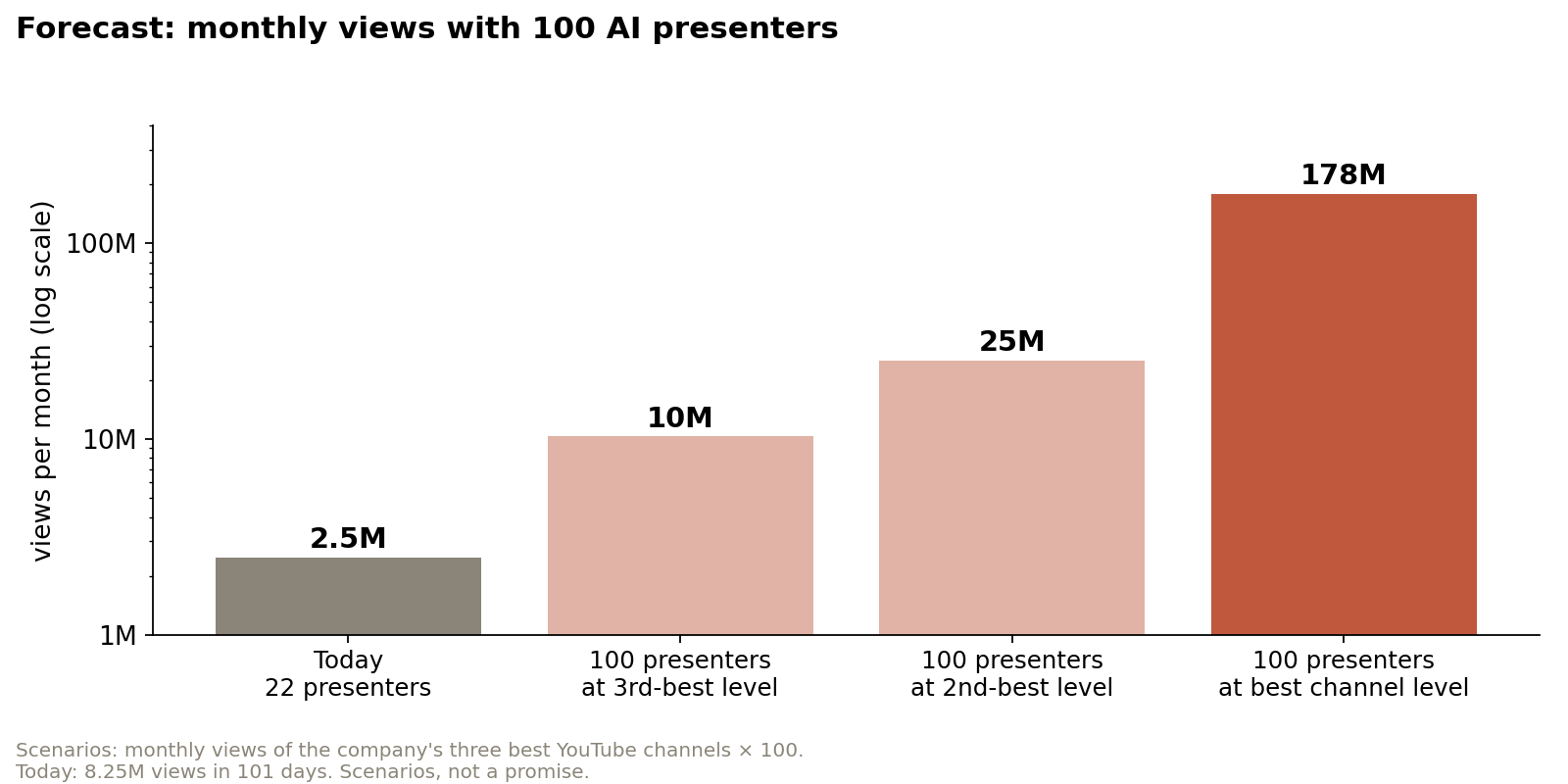
Most of the presenter channels are only a few months old, and their audiences are just starting to grow. The company's three best YouTube channels show what a mature channel looks like. The best one brings about 1.78 million views a month, the second about 250,000, the third about 100,000.
Today the whole engine brings 2.5 million views a month. If each of 100 presenters reaches the level of:
- the third-best channel, that is 10 million views a month, four times today;
- the second-best, 25 million a month, ten times today;
- the best channel, 178 million a month, about 72 times today.
The lowest scenario is close to simple arithmetic: today's output scaled from 22 to 100 presenters gives about 11 million a month.
Even the middle scenario, 25 million views a month, would cost $50,000–750,000 a month from influencers, or $56,000–414,000 a month in Meta ads at the company's own prices of $2.23–16.57 per 1,000 impressions. A human studio with 100 on-camera presenters would need a hundred people in front of the camera alone.
The forecast has limits. The best channel is an outlier: it alone brought more than three quarters of YouTube views. Not every channel will reach even the third level, growth takes months, and platforms may start limiting the reach of AI video. A hundred presenters will need more subscriptions than today. But no hiring: the service bill grows, not the payroll.
Why automation of video production is happening now
What follows is my view, not data.
Nothing stops it. There is no federal law in the US that bans businesses from producing AI video. There are platform rules on AI labels, general consumer protection rules and some state laws. New York, for example, has required ads since June 2026 to clearly disclose a synthetic performer, with a $1,000 fine for a first violation and $5,000 for repeat ones. None of that prevents a company from producing such videos.
When nothing forbids it and the price gap is more than a hundredfold, business picks the cheaper option. It happened with offshore development and with the cloud.
Neighboring professions have already felt it. On online freelance platforms, demand for writing and translation fell 20–50% against the trend after generative AI arrived (Teutloff et al., Journal of Economic Behavior & Organization, 2025), and image work orders fell 17% (Demirci et al., Management Science, 2025). Video looks next in line, and this company is an early example.
What comes next
Six predictions. In a year they can be checked, and I will come back to them.
1. The AI content engine becomes a standard department. By the end of 2027, a company that produces a lot of video without its own engine will look as odd as a company without a website does today. 2. The middle of the market is hit first. Mass UGC videos, freelance short-form video editing and outsourced social media management will feel the pressure first. Traditional studios will move upmarket, to work where clients pay for real people, real events and trust. 3. Influencers split in two. Creators whose audiences truly trust them will get more expensive, because authenticity becomes rare. Mid-tier influencers who were bought for reach will lose ground to brands' own AI avatars. 4. Production stops being an advantage. If a video costs everyone a couple of dollars, the winners are those who pick the right topics, know their audience and are patient. Organic reach responds with a delay, and the winner is whoever does not abandon a channel after a month. 5. Platforms start filtering AI video. Labels will get stricter, and repetitive videos will lose reach. This company already labels its videos as AI-generated. The winners will be those audiences trust with the label on. 6. The AI-first company is a few people plus agents. A department that used to employ dozens of people shrinks to two or three agent operators. Production goes, strategy stays.
What it means for people
Work does not disappear. It changes shape. Routine moves to AI agents. What stays valuable is what you cannot hand to an agent: taste, knowing your audience, owning the result, and being able to say "this is bad, redo it."
For video editors, voice-over artists and UGC creators this is hard news, and pretending otherwise would be dishonest. The US has 39,400 video editor jobs and 32,600 camera operator jobs (Bureau of Labor Statistics), and most marketing video is made by freelancers the statistics do not count separately. Their best move is the same one the person in this story made: become the one who runs the engine.
It is also good news. A studio that only a corporation could afford is now within reach of a small business. And you do not have to be an engineer to build one. This one was built by a single person who knows the market and can explain a task to an agent in plain words.
How to start with automated content creation
1. Know your cost of reach. What do you pay per 1,000 impressions in your ad account, and what do you pay influencers? If it is more than a couple of dollars, an AI content engine pays off faster than you think. 2. Start with one channel and one topic. Not 67. Track your cost per 1,000 views every week. 3. Hire an operator, not a programmer. Someone who knows your market and can set tasks for an agent matters more than an engineer. 4. Label AI content. It is a platform rule and the basis of trust. 5. Prove sales before you scale. Views are cheap. Customers bring the money.
What this story does not prove
One company, one category, one period. Sales and revenue are under NDA, so 52 cents is the cost of attention, not the cost of a customer. Some of the audience was built before the 101 days, and one channel brought more than three quarters of YouTube views. Platform analytics did not show where viewers live. The staffing estimate is my own: it is what the same output would cost from people, not money the company saved, and no one compared the quality of human and AI videos.
The question for business is no longer whether AI agents will replace the video studio. For one company, agents already do the studio's work. The question is who in your industry builds an AI content engine first.
The calculations behind every figure in this article are published in a technical report: doi.org/10.5281/zenodo.22802228.